Hi, it’s Ayakim 👋
Today, we’re learning how to say “is not / are not” in Korean.
Previously, we learned the affirmative forms:
If you haven’t reviewed those yet (or if you forgot), start with this lesson first.
Alright—let’s get started! 🚀
💌 Want more K-POP deep dives like this?
Subscribe to Hello Bias Letters, our free Substack newsletter!
Each week, we unpack K-POP culture with care—from fan behavior to behind-the-scenes stories.
→ Join us here
How to Make Statements and Questions with “Noun + 이/가 아닙니다” (not to be)
Let’s learn how to form sentences using today’s grammar pattern.
Here, we’ll look at both statements and questions.
The good news?
It’s simple — just attach the ending to the noun to express “is not / are not.”
Statements (Negative form)
To make a negative statement, attach 이 아닙니다 / 가 아닙니다 to the noun.
Use a falling intonation, just like when making a regular statement in Korean.
A lower tone signals that you’re giving information, not asking a question.
- 저는 학생이 아닙니다.
(jeoneun haksaeng-i animnida)
→ I am not a student. - 이것은 사과가 아닙니다.
(igeoseun sagwa-ga animnida)
→ This is not an apple.
Questions
To form a question, change the ending to 이 아닙니까? / 가 아닙니까?
The ending ~ㅂ니까? is a formal question marker in Korean.
Use a rising intonation at the end to clearly show it’s a question.
- 당신은 학생이 아닙니까?
(dangshineun haksaeng-i animnikka?)
→ Are you not a student? - 이것은 사과가 아닙니까?
(igeoseun sagwa-ga animnikka?)
→ Is this not an apple?
가 or 이 — Which one should you use?
Before 아닙니다, you must attach either 가 or 이 to the noun.
So how do you know which one is correct?
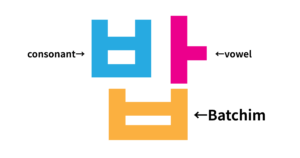
The key point is: check whether the noun ends with a final consonant (받침).
Let’s walk through it step by step with examples.
Does it have a 받침 (a final consonant) or not?
Examples:
- 콘서트장 → 장 → has a 받침
- 입구 → 구 → no 받침
- If the noun has a 받침 → use 이
- If the noun does NOT have a 받침 → use 가
Examples:
- 콘서트장 → 콘서트장이
- 입구 → 입구가
Examples:
- 콘서트장이 아닙니다.
→ It is not the concert venue. - 입구가 아닙니다.
→ This is not the entrance.
5. Practice Exercises
That’s everything for today’s lesson!
Next, we’ll move on to the practice exercises.
The more you practice, the faster it will stick — so let’s keep going! 💪✨
A. Writing Practice (Make sentences using “Noun + 가/이 아닙니다” / “~ is not”)
Hints are provided for each sentence.
- This is not water.
Hint: 이것 / 물 - I am not a student.
Hint: 저는 / 학생 - This place is not the restroom.
Hint: 여기는 / 화장실 - This person is not a singer.
Hint: 이 사람은 / 가수 - That building is not a café.
Hint: 저 건물은 / 카페
B. Translation Practice (Korean → English)
- 이것은 커피가 아닙니다.
→ English: - 저는 한국 사람이 아닙니다.
→ English: - 여기는 콘서트장이 아닙니다.
→ English:
5. Answers with Romanization
A. Writing Practice (Noun + 가/이 아닙니다)
- 이것은 물이 아닙니다.
(igeoseun muri animnida)
→ This is not water. - 저는 학생이 아닙니다.
(jeoneun haksaeng-i animnida)
→ I am not a student. - 여기는 화장실이 아닙니다.
(yeogineun hwajangsil-i animnida)
→ This place is not the restroom. - 이 사람은 가수가 아닙니다.
(i sarameun gasu-ga animnida)
→ This person is not a singer. - 저 건물은 카페가 아닙니다.
(jeo geonmureun kape-ga animnida)
→ That building is not a café.
B. Translation Practice (Korean → English)
- 이것은 커피가 아닙니다.
(igeoseun keopi-ga animnida)
→ This is not coffee. - 저는 일본 사람이 아닙니다.
(jeoneun ilbon saram-i animnida)
→ I am not Japanese. - 여기는 콘서트장이 아닙니다.
(yeogineun konseoteu-jang-i animnida)
→ This is not the concert venue.
Summary
Today, we practiced the Korean formal negative form.
Next week, we’ll learn how to make the negative form of Noun + 이에요/예요 (“is/are”) — so stay tuned!
If you subscribe to my Substack, you’ll get my Korean lessons directly by email.
I’m sending everything free for the first 1,000 subscribers, so now’s the perfect time to join if you’re learning Korean! ✨
Alright then — annyeong for now! 👋💜
💬 If you found this post helpful, consider supporting me with a coffee!
Your support keeps Hello Bias going ☕💛
👉 Buy Me a Coffee